

MGML - The Museum and Galleries of Ljubljana
UX/UI Design
One system for many expressions of art.
Year:
2025 - 2026
Type:
Professional
Focus:
User Experience
Collaboration:
Specto Design & Dev Team
Intro animation of the tenant page
Location pages navigation bars
The Challenge
How do you bring a group of very different cultural institutions into one digital system without making them all feel the same?
The Museum and Galleries of Ljubljana (MGML) brings together several museums, galleries, and cultural spaces under one organisation. Before this project, each location had its own website, which meant different structures, different visual rules, and a different user experience depending on where you landed. Each site worked on its own, but the connection to MGML as a whole was weak.
A lot of the content was similar across them, exhibitions, collections, events, but the way it was organised changed from one site to another. That made navigation less predictable and made the overall experience feel fragmented, especially for visitors moving between locations.
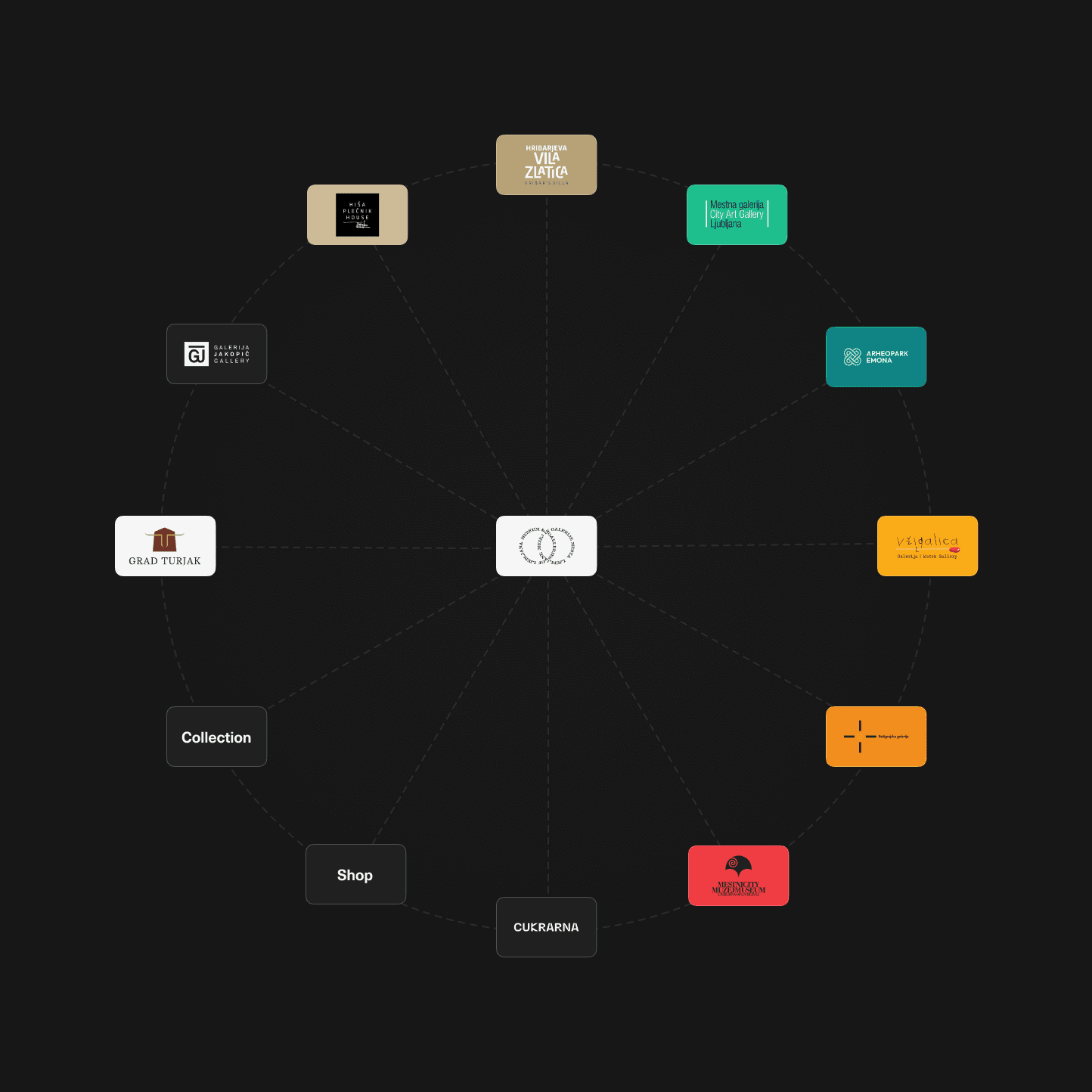
The challenge was to build a shared framework that introduced consistency and recognisability without flattening the identity of each museum. The point was not to standardise everything. It was to create a system where structure and individuality could sit next to each other without fighting.
Context & Position
The project was developed in a professional setting and in close collaboration with the client. It started with an analysis of the existing museum websites, followed by workshops with the client and research into comparable cultural platforms. From there, a new system began to take shape, with the goal of making navigation simpler and the overall experience more coherent across all MGML institutions.
My role focused on structure, UX, and UI design. Together with the team, we developed a component-based system that included navigation patterns, cards, carousels, and page templates. Those components needed to be flexible enough to work with the existing brand guidelines of each museum, so their individual visual identities could still come through without breaking the system.
The process was iterative and shaped by regular feedback. Weekly meetings with the client helped us stay aligned on structure, visual direction, and usability, while allowing the system to keep evolving.
Components
Design Thinking & Decisions
The core of the project was the structure. It had to work across multiple museums and galleries, even though the institutions themselves were quite different. Some were more historical, some more modern art focused, and some sat somewhere in between. The system had to feel clear and predictable across all of them.
That consistency came from shared navigation patterns and reusable page structures. A central MGML platform was introduced to bring together key information like events and exhibitions, creating a connecting layer between the individual locations. That gave users a clearer sense of the organisation as a whole, while still letting each institution keep its own presence.
At the same time, the system had to make room for difference. Each museum already had its own visual identity, and that mattered. Logos, colours, and typography from their brand guidelines were applied through a shared set of components, so the experience stayed connected without becoming visually flat. A lot of the work was in the balancing. The layouts needed to hold together even when the visual styles shifted, which meant paying close attention to spacing, typography, and image handling.
Navigation through locations
Location brand identity applied to hero module
Iteration & System Expansion
Most of the bigger changes happened in the visual refinement. The structure was defined relatively early, but getting different identities to sit comfortably inside the same framework took more adjustment. Every location needed its own visual tuning to find the point where it still felt distinct without pushing too far away from the rest of the system.
The structure itself did not change dramatically after that. Most of the later refinements were smaller and more practical. The focus moved toward simplifying content and making the important things easier to find. Navigation and page layouts were streamlined, non-essential elements were moved, and information like opening times, tickets, and current events was given more emphasis.
Client feedback was a big part of that process, especially when it came to the visual direction of each institution. The regular reviews helped keep both sides of the project in balance: consistency across the system, and identity within each site.
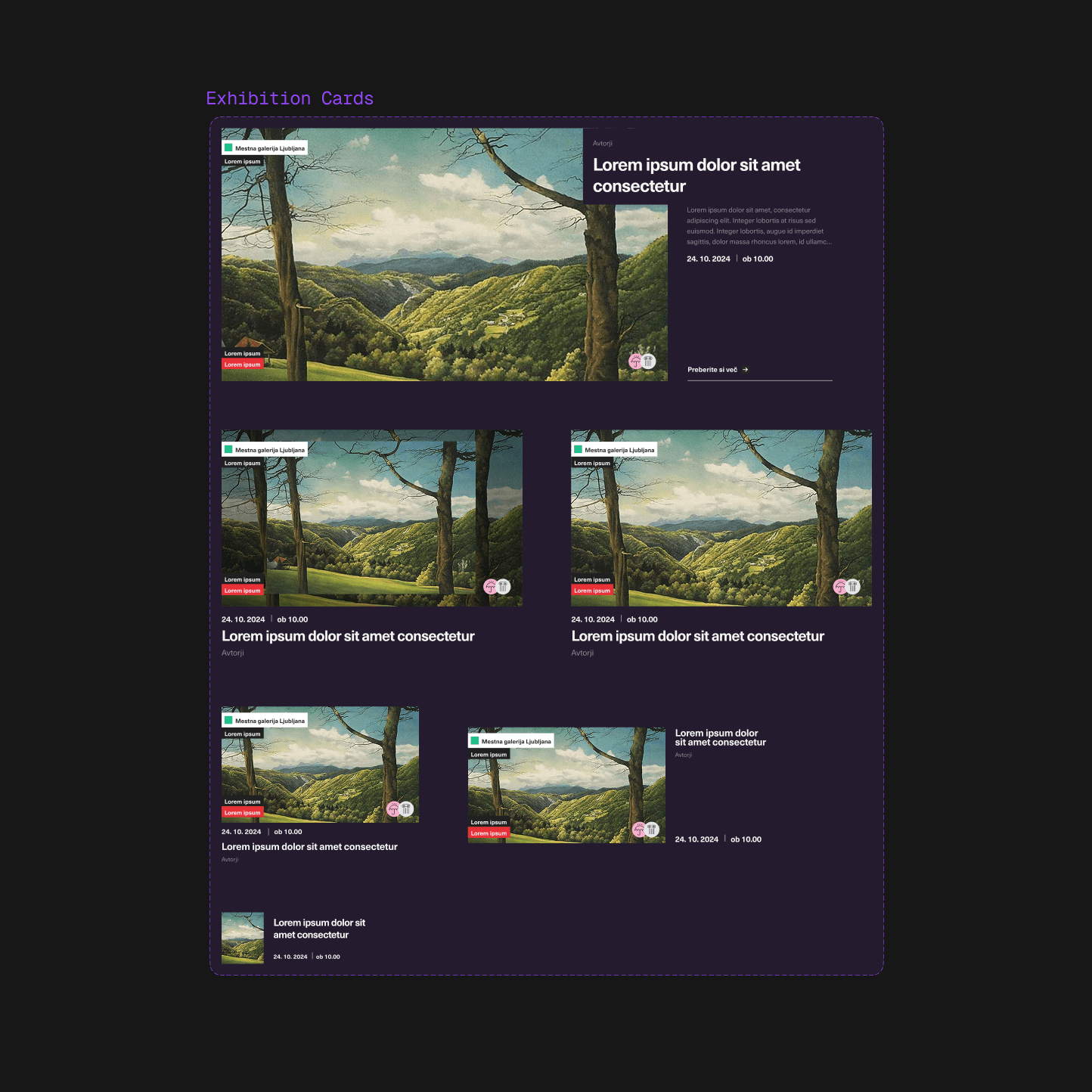
Different versions of the exhibition card
Different versions of the exhibition card
Outcome & Reflection
The final result was a digital system that clearly connects all museums and galleries under the MGML organisation. The shared structure makes that relationship visible, while the individual institutions still retain their own identity.
It also made the experience more usable. Key information is easier to get to, navigation is more predictable, and the sites feel more coherent as a group.
If the project continued, I would probably focus next on subtle motion and interaction, and on refining the component system even further so the whole network feels more connected without becoming too uniform.
It was also a useful project for me because it pushed the way I think about systems. Designing one website is one thing. Designing a framework that has to stay consistent across many contexts is another. It also reinforced how important close collaboration with stakeholders is when you are trying to balance institutional needs with a clear user experience.